Fox Paving - Paving Contractor
Buried stream channels leave sand lenses and clay plugs in patterns no surface survey detects, causing identical specs to fail on adjacent lots. We use cone penetration testing at 50-foot grids to map these variations before designing base treatment. Harris and Montgomery County licensed. Biologists welcome the canopy; we engineer it.
Twelve years of reading Texas soil before touching asphalt taught us that assumptions are expensive. As a paving contractor working Spring, TX, we arrive with splitspoon samplers, falling head permeameters, and the stubbornness to wait for lab results before quoting. Our crews are ours alone, no day labor, no subcontractor networks, no accountability gaps.
Spring, TX occupies a hydrological crossroads. The eastern third drains through the sandy terraces of Cypress Creek toward Lake Houston, where water moves fast and carries base material with it. The western twothirds sit on the Montgomery County clay cap, a layer so impermeable that developers joke about needing scuba gear to pour foundations. Between these zones lies a transition band where ancient stream meanders left behind lenses of sand, clay, and organic muck in patterns no surface survey can predict. This geological lottery means identical pavement specifications fail on adjacent lots. Compounding the challenge, Spring’s 1980s and 1990s development boom preceded modern geotechnical standards. The result is a landscape of premature failures: parking lots along FM 1960 that settled differentially within five years, residential drives in Gleannloch Farms where clay heave cracked asphalt seasonally, and commercial pads near the Woodlands border where sandy washout created sinkholes beneath pavement. We map these conditions before designing, not after apologizing.
We hold TDLIC registration, Texas Department of Insurance coverage, and a warranty that transfers to subsequent property owners. Whether you’re maintaining retail along Interstate 45, stabilizing a residential collection in Lexington Woods, or preserving access for the light industrial corridor near Hardy Road, we treat your Spring surface as our own liability.
Fox Paving operates as a paving contractor across Spring, TX producing asphalt overlays, sealcoating, crack remediation, parking lot preservation, speed control installations, and pavement marking. Each specification derives from geotechnical investigation, permeability testing, and traffic load modeling rather than regional rule of thumb.
Spring, TX overlay engineering confronts the lens problem: ancient stream channels buried beneath apparent uniformity. A property that tests as stable clay at the front may harbor saturated sand lenses at the rear that liquefy under vibration. We use cone penetration testing at 50foot grids to map these variations before specifying base treatment. Sandy zones receive cementstabilized subgrade; clay areas get lime treatment; transition zones require geogrid reinforcement. The overlay mat itself is specified by traffic: polymermodified binder for the I45 commercial corridor, standard performance grade for residential drives. Benefits include 16 to 20 years of service life when subgrade is honestly characterized, cost avoidance exceeding 70 percent versus full depth reconstruction for properties with sound structural sections, elimination of the differential settlement that creates trip hazards and drainage reversals, and reengineered crossfall that sends water toward positive outfall rather than accumulating against building foundations.
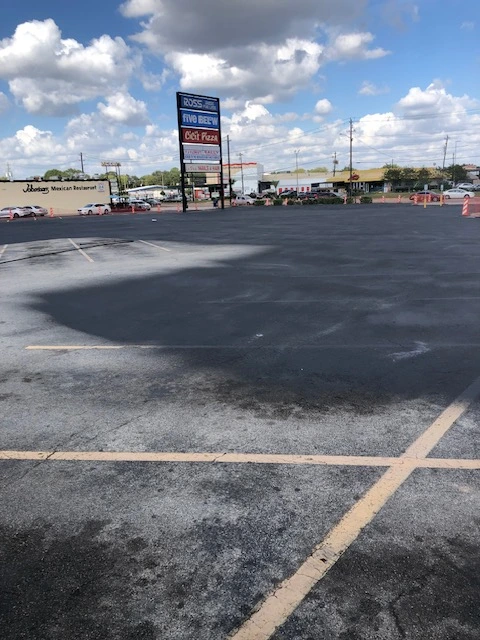
Spring’s sealcoating challenge is microbial. The combination of clay cap impermeability, extended surface wetness, and organic matter from the area’s dense canopy creates ideal conditions for algae, lichen, and fungal colonization. These organisms secrete acids that degrade binder chemistry and create slippery biofilms that standard sealants cannot bond to. We begin with sodium hypochlorite treatment to kill biological growth, follow with high pressure rinse and alkaline neutralization, then apply a coal tar latex hybrid with biocide additives. Benefits include functional lifespan extension of 150 percent when reapplied every 24 to 30 months shorter than standard cycles due to biological stress restoration of the friction coefficient that safety codes require for pedestrian and vehicular traffic, a moisture barrier that prevents the anaerobic conditions beneath Spring’s clay cap that accelerate base decomposition, and budget smoothing that replaces the emergency patching triggered by each wet season’s biological bloom.
Repair diagnosis in Spring, TX requires distinguishing three failure signatures that mimic each other superficially. Sand lens liquefaction creates bowlshaped depressions with radial cracking. Clay shrinkage produces parallel longitudinal cracks with vertical displacement. Organic decomposition generates irregular sinkholes with no distinct pattern. We use ground penetrating radar to classify the failure mechanism before selecting intervention: vibro replacement stone columns for liquefaction, lime stabilization for clay shrinkage, and excavation with geotextile encapsulation for organic zones. Benefits include elimination of the misdiagnosed repairs that fail within six months, restoration of load capacity for the commercial and logistics traffic defining Spring’s economy, interruption of the water pathways that propagate failure across apparently sound adjacent areas, and surgical precision that preserves undamaged sections and stretches capital improvement timelines.
Crack morphology in Spring, TX reveals the buried geology. Chevron patterns pointing downslope indicate sand lens movement beneath. Parallel longitudinal cracks with vertical offset signal clay shrinks well. Random block patterns suggest organic decomposition. Star bursts around a central point indicate ironstone or concretion puncture. We classify each pattern before selecting sealant chemistry and installation method: flexible polyurethane for moving cracks, rigid epoxy for static cracks, and full depth reconstruction for organic voids. Benefits include an approximate 90 percent reduction in water infiltration that triggers pothole formation, pavement life extension of 6 to 8 years with annual treatment in Spring’s aggressive environment, prevention of the biological colonization that exploits cracks within 48 hours of rainfall, and traffic reopening within 60 minutes using rapidcure formulations formulated for humid cure conditions.
Spring, TX maintenance programs must address the area’s canopy cover, which creates microclimates distinct from openfield markets. Shaded sections remain wet 40 percent longer than sun exposed areas, accelerating biological growth and binder degradation. Our programs incorporate zone specific protocols: shaded areas receive biocide enhanced sealcoating at 20month intervals, sun exposed areas follow standard 36month cycles, and transition zones get intermediate treatment. Drainage cleaning is scheduled quarterly rather than biannually due to leaf litter accumulation. Benefits include functional lifespans reaching 25 years under zone calibrated care, sustained compliance with ADA requirements that evolve with Department of Justice interpretation, aesthetic standards that support tenant recruitment in Spring’s competitive retail and medical markets, and elimination of the emergency failures.
Spring TX speed control installations navigate Montgomery County emergency access standards while addressing the area’s distinctive traffic ecology: school zones with concentrated pedestrian activity, medical corridors with ambulance throughput requirements, and the heavy equipment servicing the I45 logistics and light industrial zones. We construct asphalt tables with variable geometry calibrated by zone: 18foot transitions and 2.5inch peaks for school zones where low ground clearance is common, 14foot transitions and 3.5inch peaks for standard commercial, and reinforced edges with steel dowels for industrial areas where forklift and delivery truck contact is daily. Benefits include measured speed reductions of 30 percent in school zones and 45 percent in commercial areas, documented reductions in pedestrian incidents that satisfy insurance underwriters and liability counsel, construction durability that withstands the mixed vehicle spectrum from compact hybrids to 26foot box trucks, cycles.
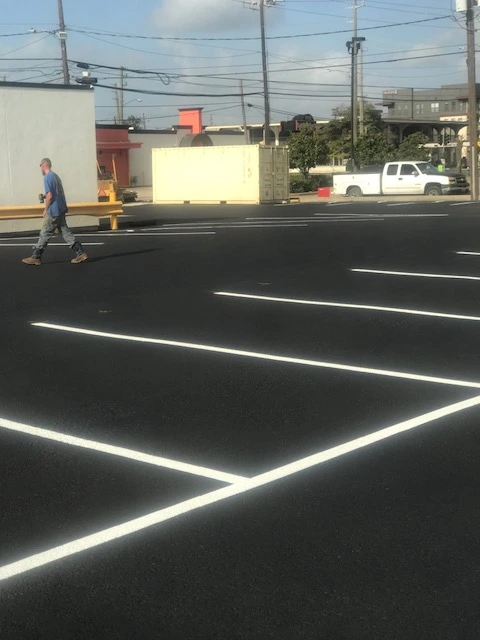
Pavement marking in Spring, TX degrades through mechanisms distinct from both coastal and inland Texas markets. The canopy cover reduces UV exposure slowing photodegradation but increases humidity and biological film accumulation that masks pigments and reduces retroreflectivity. Leaf tannins stain standard latex formulations within 18 months. We specify two component epoxy with biocide additives for shaded areas, standard thermoplastic for open zones, and MMA with enhanced dirtshedding chemistry for transition areas. Benefits include ADAcompliant restriping that satisfies current enforcement interpretation, traffic pattern optimization that reduces conflict points where Spring’s medical and retail volume creates congestion during shift changes, nighttime visibility that supports security objectives for properties with extended hours, and surface longevity synchronized with zonespecific sealcoating intervals for integrated maintenance scheduling.
Contact Fox Paving today for paving contractor evaluation in Spring, TX. Complimentary site assessment with geotechnical investigation and written scope. Address your pavement issues before spring biological bloom turns minor cracks into structural compromise.
Cone penetration testing provides continuous resistance profiles at 2centimeter intervals, revealing sand lenses and organic layers that discrete borings miss. For Spring’s lensdominated geology, this resolution is essential. We deploy CPT at 50foot grids before specifying base treatment.
Lake Houston influence zones experience seasonal water table fluctuation that saturates and desaturates subgrades cyclically. This pore pressure variation creates pumping action that ejects fines from beneath pavement. Inland clay cap properties fail through shrinkswell heaving. The repair methodologies differ fundamentally.
Drippy decomposition of organic matter from overhanging oak and pine canopies. The tannins and lignins stain asphalt and accelerate binder oxidation in shaded areas. Biocideenhanced sealcoating prevents recurrence; pressure washing with alkaline cleaner removes existing staining without binder damage.
March and April pollen accumulation creates a bonding barrier that prevents proper sealant adhesion. We suspend sealcoating during peak pollen and schedule for MayJune or SeptemberOctober when pollen loads diminish and humidity remains manageable for proper cure.
Properties within the Spring Creek floodplain require elevated finished grades, permeable paving or detention systems, and overflow capacity that standard parking specifications omit. We coordinate with county floodplain administrators to maintain parking capacity while satisfying regulatory requirements.